

The best backpacking tent for solo hikers is the Mountain Hardwear Nimbus UL 1 — it drops below 2 pounds without sacrificing livable headroom or the dry vestibule space you need on multi-day trips. For two-person trips where weight matters, the NEMO Hornet OSMO Ultralight 2P is our top ultralight pick, breaking the 2-pound barrier while keeping dual doors and dual vestibules. If you're outfitting a three-person crew, the MSR Hubba Hubba LT 3 delivers genuine shoulder room for three adults without crossing into car-camping weight territory.
9 backpacking tents scored across 7 criteria — weather resistance, durability, value, packweight, livable space, ease of setup, and user reviews. Last updated: May 2026.
The most important gear decision you make before any backpacking trip is not your pack, your boots, or your sleep system…it is your tent!
A bad sleeping bag makes for a cold night. A bad tent in a real rainstorm makes for a ruined trip, a soaked sleeping bag, and a genuinely miserable situation if temperatures drop overnight.
The good news is that the backpacking tent market in 2026 has never been better calibrated across price points, and you do not need to spend $500 to get a genuinely reliable shelter.
We evaluated nine fantastic backpacking tents here, organized by capacity, with a premium pick, a budget pick, and a specialty pick at each size category.
Whether you are heading out solo for the first time or shopping for a three-person shelter that does not punish you on the uphill, there is a clear recommendation here for your situation.
Solo Backpacking Tents
- Best Solo Ultralight Backpacking Tent: Mountain Hardwear Nimbus UL 1 — drops below 2 pounds without sacrificing livable headroom or vestibule space
- Best Budget Solo Backpacking Tent: Clostnature One-Person Tent — delivers double-wall protection and a genuine vestibule for under $75
- Best Backpacking Tent for Hot Weather: ALPS Mountaineering Zephyr 1-Person — full mesh canopy moves air better than any other tent in this weight class
2-Person Backpacking Tents
- Best Premium 2-Person Backpacking Tent: NEMO Hornet OSMO Ultralight 2P — breaks the 2-pound barrier for two people while keeping two doors and two vestibules
- Best Versatile 2-Person Backpacking Tent: MSR FreeLite 2 — balances serious three-season weather protection with packable weight across the full range of conditions
- Best Budget 2-Person Backpacking Tent: Kelty Grand Mesa 2 — reliable three-season performance with a clean three-minute setup, strong entry point for first-time backpackers
3-Person Backpacking Tents
- Best Premium 3-Person Backpacking Tent: Big Agnes Copper Spur HV UL3 — vertical walls and a sub-4-pound pack weight for trips where comfort and mileage both matter
- Best Spacious 3-Person Backpacking Tent: MSR Hubba Hubba LT 3 — gives three adults genuine shoulder room without crossing into car-camping weight territory
- Best Value 3-Person Backpacking Tent: Marmot Tungsten 3 — transitions cleanly from weekend backpacking trips to established campground stays without compromising on either
→ See how we score and evaluate every tent on this list — graded across 7 criteria, including weather resistance, durability, and value.
Best Backpacking Tents for 2026 – Our Top Picks
Mountain Hardwear Nimbus UL 1 Tent

The Nimbus UL 1 is built for solo backpackers chasing packweight savings without sacrificing livable space inside.
At 1.9 pounds of trail weight, it undercuts most ultralight tents by a meaningful margin while still offering 20 square feet of floor area, which is enough room to sit upright and store a pack inside on rainy nights.
The DAC Featherlight NFL poles keep the structure stable in wind, and the three-quarter mesh canopy strikes a practical balance between ventilation and weather protection without adding unnecessary fabric weight.
The double-silicone rainfly sheds water efficiently and packs down smaller than polyester alternatives, though it requires more careful tensioning in cold conditions when the material stiffens slightly.
The front dry-entry vestibule gives you a protected space to stash boots and a wet rain jacket without tracking moisture into the sleeping area, and the G-Hook canopy attachment system makes setup intuitive even in low light.
The floor fabric is thin enough that a footprint becomes necessary on rocky or abrasive ground, and the opposite-side door placement means you'll need to crawl over your gear to exit, which becomes awkward on longer trips where organization matters.
But this tent will frustrate anyone who camps frequently on rough terrain or wants quick middle-of-the-night access without disturbing their gear layout.
Pros
- Trail weight of 1.9 pounds makes it one of the lightest solo shelters available
- Sets up in three minutes with color-coded pole clips
- Double-silicone rainfly resists tearing and packs down exceptionally small
- 20 square feet of floor space fits a full-length sleeping pad with room left over
- Front vestibule keeps gear dry without cluttering the interior
Cons
- Thin floor requires a footprint on rocky ground
Best For: Solo ultralight backpackers prioritizing packweight on multi-day trips
Clostnature One-Person Tent
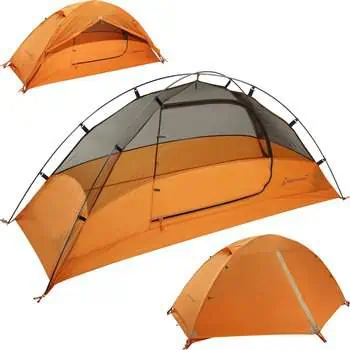
This is the tent for solo hikers who need reliable shelter without spending triple digits, especially those splitting time between trail and car camping.
The PU 5000 waterproof coating handles steady rain better than most tents at this price point, and the ripstop polyester fly resists tearing when brushed against branches or packed wet.
The 4.2-pound trail weight makes this a poor choice for ultralight backpackers counting ounces, and several owners report water seepage along the zipper track during prolonged downpours.
This tent belongs in the budget camping shelter category rather than the premium backpacking space, and it shows with a slight weight penalty coming at 4.2 lbs.
Owners consistently report pitching it solo in under five minutes using the straightforward two-pole system, which matters when you're setting up in fading light after a long day on trail.
Pros
- PU 5000 waterproof coating outlasts cheaper polyurethane treatments
- Ripstop polyester fly resists punctures and abrasion
- Two-way zippers with Velcro sleeves prevent snags
- Sets up in 5 minutes with simple two-pole design
- Costs under $75 with full rainfly coverage
Cons
- 4.2-pound weight is heavy for solo backpacking
- Zipper allows water seepage during heavy rain
Best For: Budget-conscious solo campers splitting time between trail and car camping
ALPS Mountaineering Zephyr 1-Person Tent
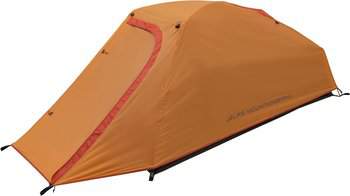
The Zephyr is built for solo campers who prioritize breathability over packweight, especially in humid summer conditions where condensation becomes a real problem.
The tent uses a high-mesh design that keeps air moving through the interior even on still nights, and the 75D polyester fly resists sagging better than lighter fabrics when morning dew sets in.
At 4 pounds 12 ounces, this tent is too heavy for serious backpackers counting ounces on multi-day trips.
The pole tips also fit loosely in their grommets, which several owners report as frustrating during setup, particularly in wind.
This tent works for short overnight trips, but it will slow you down on longer backcountry routes where ultralight tents make more sense.
Pros
- 36-inch peak height allows comfortable sitting room inside
- Freestanding two-pole setup pitches in about five minutes
- 75D polyester fly stays taut in wet conditions
- Includes gear loft and mesh storage pockets
- Limited lifetime warranty covers manufacturing defects
Cons
- 4 lbs 12 oz trail weight limits backpacking range
- Pole tips fit loosely in grommets during setup
Best For: Solo car campers prioritizing ventilation in humid weather
NEMO Hornet OSMO Ultralight 2P Tent
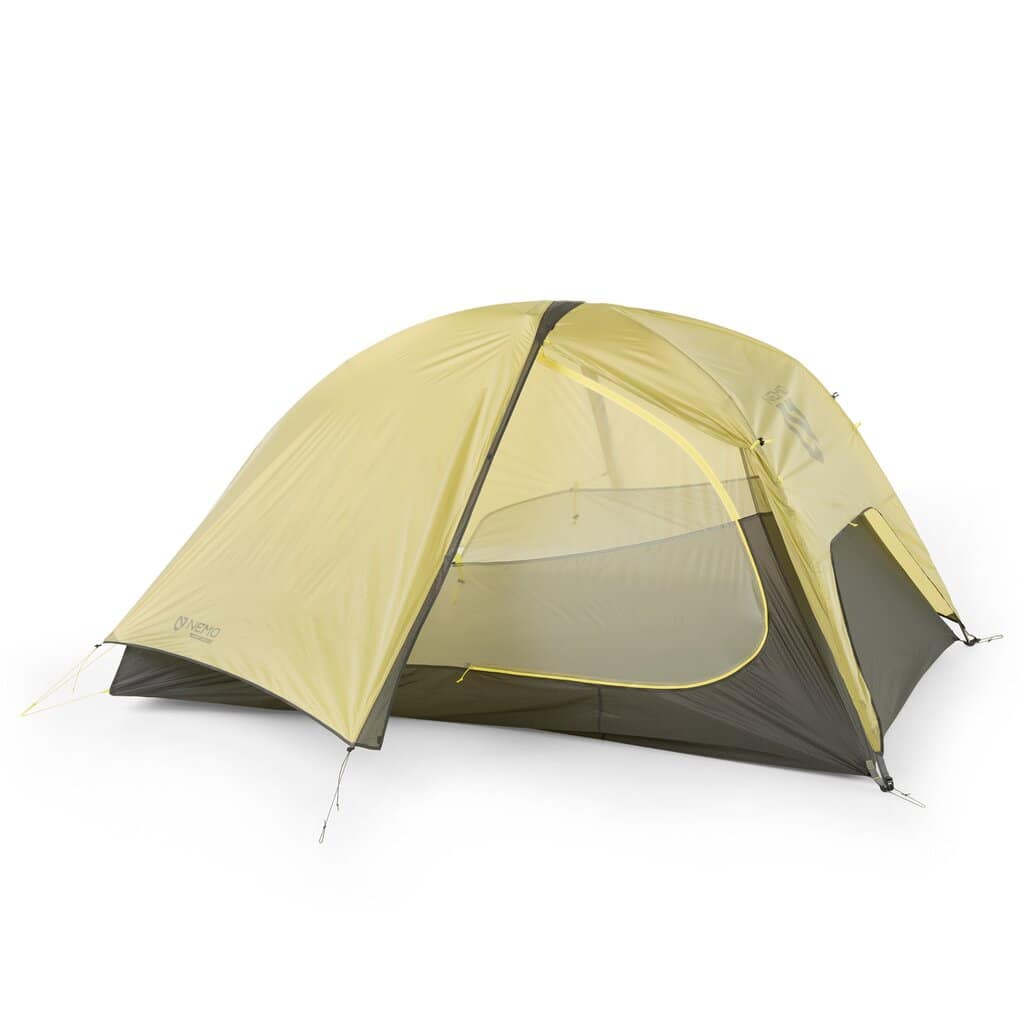
This is the tent for solo backpackers who want a legitimate two-person space without carrying a pound more than necessary (though it is admittedly tight).
At 2.1 lbs trail weight, the Hornet OSMO undercuts most competitors in its floor area class while delivering 28 square feet of usable interior and dual vestibules for gear management.
NEMO's OSMO fabric resists the wet-weather sag that plagues silnylon shelters, which means you won't wake up to a sagging fly pressed against the mesh after a night of condensation.
The single-pole design pitches fast enough that owners regularly report sub-five-minute setups on their first attempt, and the Nightlight Pockets turn your headlamp into ambient tent lighting without fumbling for a lantern hook.
The real limitation is headroom and shoulder width for actual two-person use.
At 39 inches peak height and a tapered floor, this tent works beautifully for one person with gear or two people who are comfortable sleeping close and don't mind limited sit-up space.
If you're planning a week-long trip with a partner who needs their own gear zone and elbow room, this tent will feel tight by night three.
Pros
- 2.1 lbs trail weight delivers serious packability for solo trips
- OSMO fabric eliminates the stretch and sag common in wet conditions
- Dual doors and vestibules prevent the midnight crawl-over
- Single-pole setup pitches in under five minutes with no learning curve
- Nightlight Pockets turn your headlamp into usable ambient lighting
Cons
- 39-inch peak height limits sit-up room for taller campers
- Tapered floor feels cramped with two full-size sleeping pads
Best For: Solo backpackers who want two-person space at ultralight weight
MSR FreeLite 2 Tent
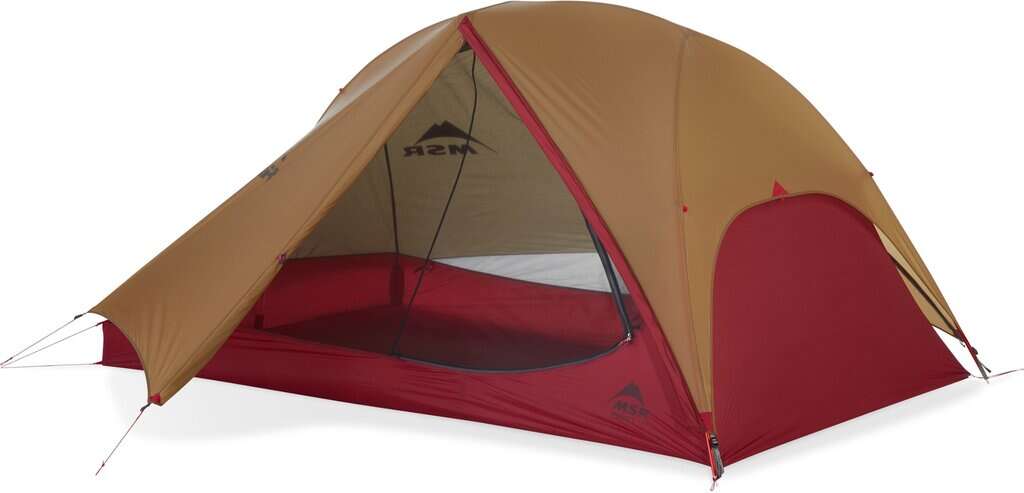
This is the tent for solo backpackers who want maximum livable space without carrying extra ounces.
At 2 pounds 5 ounces, the FreeLite 2 delivers 29 square feet of floor area in a package that weighs less than most true one-person shelters, and the rectangular floor shape fits wide sleeping pads without the tapered footbox squeeze common in ultralight designs.
The single-pole setup pitches fast, but the thin fabrics demand careful handling around sharp objects and rocky ground.
This tent works best for experienced backpackers who pack light and know how to set up a tent properly, but it will frustrate anyone hoping to comfortably fit two adults or rough-handle gear in camp.
Pros
- Weighs just 2 lbs 5 oz for serious packweight savings
- Rectangular 29 sq ft floor fits wide sleeping pads
- Sets up in 2 minutes with intuitive single-pole design
- Two side-entry vestibules eliminate crawling over gear
- Tech-friendly pockets with cable ports keep devices organized
Cons
- Tight quarters for two larger hikers
- Thin fabrics require careful handling on rough terrain
Best For: Solo backpackers prioritizing weight savings and livable space
Kelty Grand Mesa 2 Tent
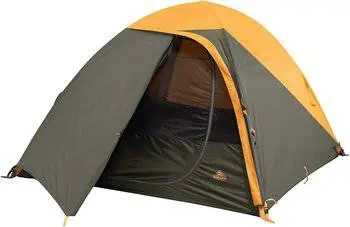
The Grand Mesa 2 is built for solo backpackers who want a proven freestanding shelter without spending $300 on ultralight materials.
At 4 lbs 12 oz, it's light enough to carry on multi-day trips without requiring you to cut your toothbrush in half, and the Quick-Corner pole system lets you pitch it in under three minutes even if you're new to backpacking.
The half-zip vestibule is the real limitation here: you can't fully close it from inside, which means rain will work its way in if you're pitched on exposed ground in heavy weather.
This tent is not the right choice for alpine camping or extended trips in consistently wet conditions, where full vestibule coverage becomes essential.
Pros
- Pitches in 3 minutes with Quick-Corner pole system
- 4 lbs 12 oz packweight makes it manageable for solo trips
- 30 sq ft floor area provides room to spread out
- Shark Mouth carry bag simplifies packing and unpacking
- Affordable entry point for new backpackers under $200
Cons
- Half-zip vestibule doesn't seal fully in rain
- Stakes bend easily and need upgrading
Best For: Solo backpackers prioritizing affordability and straightforward setup over ultralight packweight
MSR Hubba Hubba LT 3 Tent

This is the tent for two or even three backpackers who want real space without having to carry a brick.
At 4 lbs 13 oz, it splits comfortably between partners while delivering 47 square feet of floor space, which is enough to keep two wide pads from touching and still leave room for gear you'd rather not leave in the vestibules.
The unified hub-and-pole system means you can pitch this solo in under three minutes, even if your partner is still filtering water, and owners consistently mention the straight-line zippers working smoothly with one hand when you're half-asleep.
The StayDry doors with built-in rain gutters handle condensation better than most tents at this weight, and the kickstand vents let you crack airflow without inviting rain inside.
The overhead gear lofts and cable port pockets are thoughtful touches that keep headlamps and phones within reach instead of buried in a stuff sack.
The weakness here is ventilation in hot, humid conditions.
The solid wall panels that keep rain out also trap heat, and several owners report waking up sticky on summer nights below treeline when there's no breeze.
If you're camping in the Southeast in July or anywhere else where overnight lows stay above seventy, you'll want a tent with more mesh panels, not less.
Pros
- 47 sq ft floor fits two wide pads with gear space or three shoulder to shoulder
- Weighs under 5 lbs, easy to split between partners
- Sets up in 3 minutes with unified hub-and-pole system
- StayDry doors with rain gutters reduce condensation drip
- Straight-line zippers open smoothly with one hand
Cons
- Solid wall panels trap heat in humid summer conditions
- Not truly lightweight compared to ultralight alternatives
Best For: Two backpackers splitting weight who want real floor space and a fast setup
Marmot Tungsten 3 Person Tent
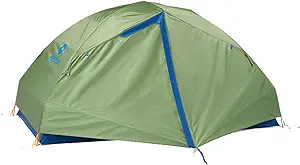
The Tungsten 3P is built for the camper who splits time between car camping weekends and occasional overnight backpacking trips where weight matters but not obsessively.
At 6 pounds even, it sits in the crossover zone between true backpacking tents and campground shelters, light enough to carry on moderate trails without wrecking your back but roomy enough that you won't feel cramped after a long day hiking.
The fly's water resistance falls short in sustained rain, which several owners report as condensation buildup and minor seepage during multi-day storms.
This is not the tent for exposed alpine camps or anyone planning extended trips in wet climates.
Pros
- Color-coded poles make first-time setup genuinely intuitive
- Near-vertical walls maximize usable floor space inside
- Included footprint adds ground protection without extra cost
- 41 sq ft floor provides room for one person plus gear
- Affordable for a tent that handles both trail and campground use
Cons
- Fly lacks full weatherproofing in sustained rain
- Heavier than dedicated backpacking tents at this price
Best For: Weekend backpackers who also car camp regularly
Big Agnes Copper Spur HV UL3 Tent
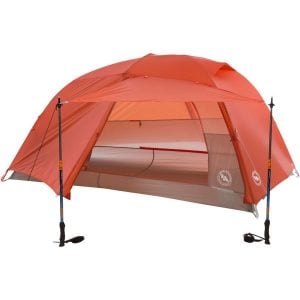
The Copper Spur HV UL3 is built for backpackers who want ultralight performance without sacrificing livable space.
At 3 pounds 8 ounces minimum weight, it undercuts most three-person tents by a full pound while still delivering 41 square feet of floor area and dual vestibules for gear storage.
The proprietary HyperBead fabric construction keeps weight down through strategic reinforcement rather than uniform thickness, but this comes at a cost: the floor material is genuinely fragile and punctures more easily than heavier alternatives.
Owners camping on rocky or root-heavy sites consistently report needing a footprint or groundsheet to prevent damage, and several note the zippers catching or sticking when dirt accumulates in the track.
This is not the tent for casual car campers who set up once a season and expect bombproof durability, but for weight-conscious backpackers willing to treat their gear carefully, it delivers exceptional space-to-weight efficiency on ultralight trips.
Pros
- 3 lbs 8 oz minimum weight is exceptionally light for 41 sq ft
- Dual vestibules provide separate gear storage for two people
- 43-inch peak height allows comfortable sitting inside
- Sets up in under 5 minutes with color-coded poles
- HyperBead fabric cuts weight without compromising waterproofing
Cons
- Floor material punctures easily on rocky ground
- Zippers stick and catch when dirt accumulates
Best For: Weight-conscious backpackers prioritizing packability over bombproof durability
How to Choose a Backpacking Tent
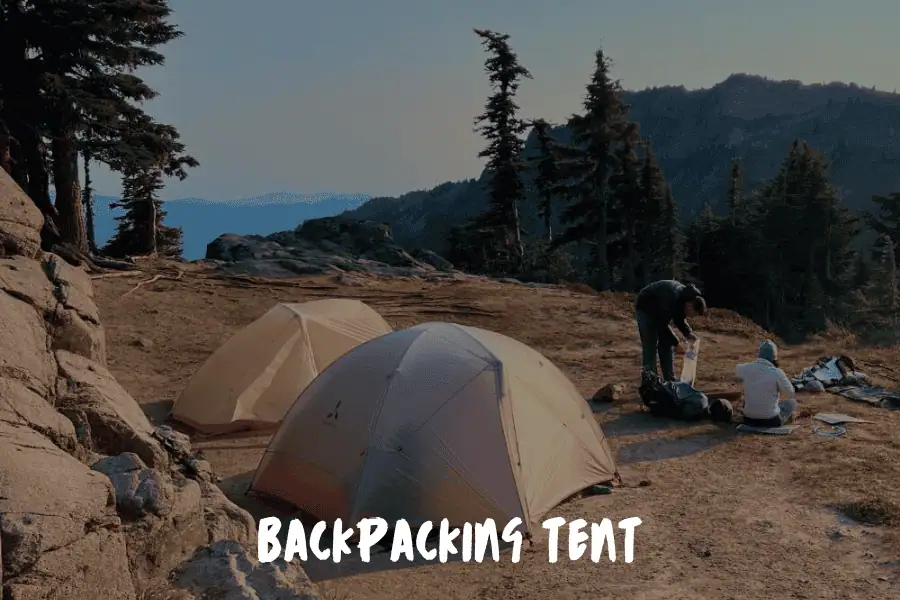
The right backpacking tent depends on three things: how far you are going, how many people are sleeping in it, and what conditions you are likely to encounter.
Everything else, including price, brand, and features, flows from those three answers.
Weight: The Number That Shapes Everything
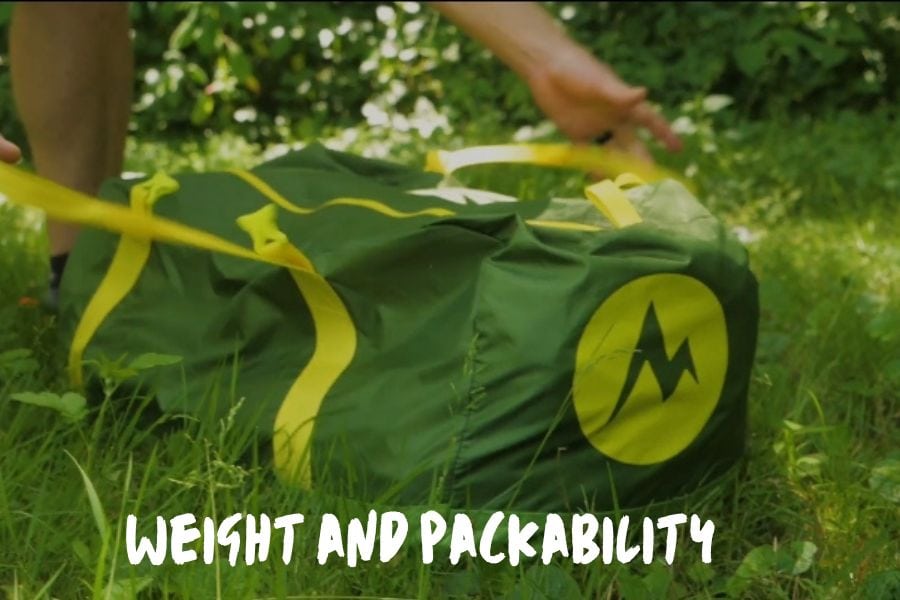
Every pound in your shelter is a pound you carry for every mile of the trip, which means tent weight compounds in a way that gear weight in your car simply does not.
For most three-season backpackers, a tent in the 2 to 3.5 pound range for a solo or duo shelter is a reasonable starting point that does not require sacrificing durability or weather protection.
Under 2 pounds puts you in ultralight territory, where you are trading some floor space, pole robustness, or material thickness for the weight savings.
Over 4 pounds for a solo tent is generally too heavy for serious trail use, though some group shelters in the 3-person category earn that weight through genuine extra livability.
The most useful framework is per-person weight: a 3-pound two-person tent means each hiker carries 1.5 pounds of shelter, which is competitive with many solo ultralight options.
Read more: How Much Should a Backpacking Tent Weigh?
Also see: Backpacking Base Weight: What It Is and How to Hit Your Target
Capacity: Sizing Up vs. Sizing Right
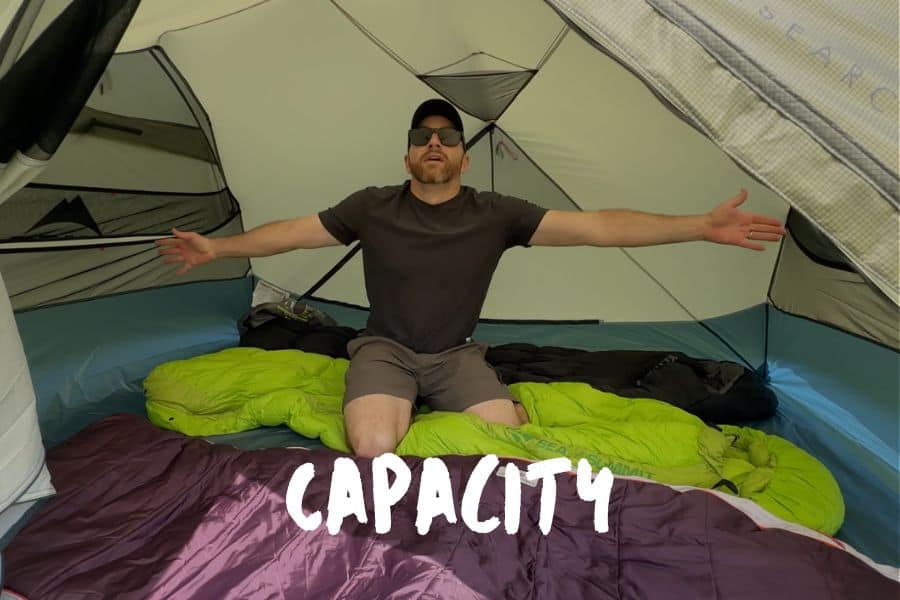
Tent capacity ratings are consistently optimistic, and backpacking tents are no exception.
A "2-person" backpacking tent is typically sized for two adults sleeping shoulder to shoulder with no gear stored inside.
The practical rule for backpacking is to match the stated capacity to the number of people, then store gear in the vestibule rather than inside the tent.
If you want genuine room to move, size up by one: a couple that wants to sleep comfortably with space for their packs will be much happier in a 3-person tent than a 2-person.
For solo backpackers, a 1-person tent saves meaningful weight but a 2-person tent buys significantly more interior space and comfort, which matters on multi-night trips where you are spending real time inside.
See more: Find Tents by Comfort Sleeping Capacity
Three-Season vs. Four-Season
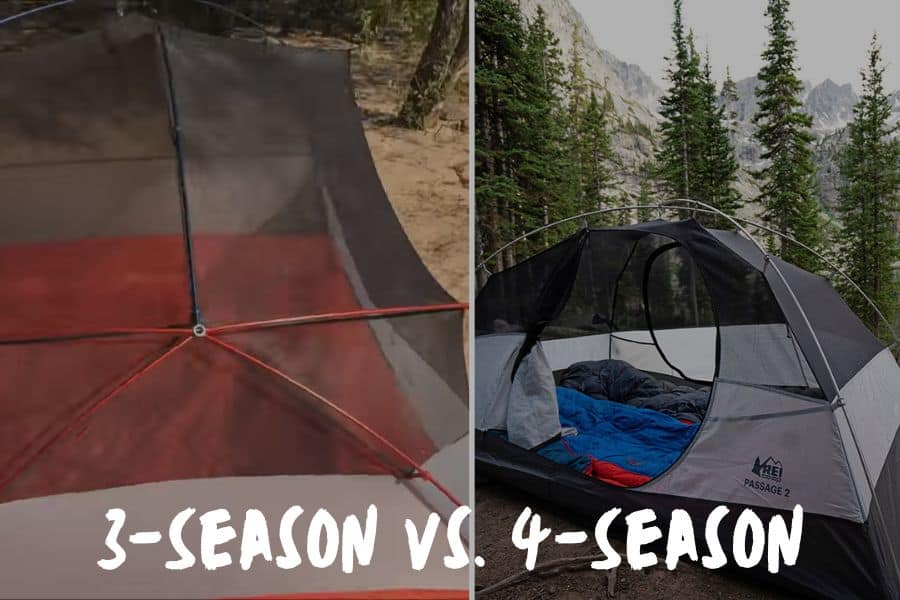
The vast majority of backpackers need a three-season tent, and the vast majority of backpacking tents on the market are three-season designs.
A three-season tent handles spring through fall conditions: rain, wind, and cold nights down to around 20 degrees Fahrenheit with a proper sleep system.
What it is not designed for is sustained snow load, high-alpine wind exposure above treeline, or winter mountaineering conditions where structural failure is a genuine risk.
A four-season tent uses additional poles, heavier fabrics, and a more enclosed geometry to handle those conditions, at the cost of more weight and less ventilation in warm weather.
If your trips stay on marked trails below treeline from spring through fall, a three-season tent is the right choice every time.
Read more: 3-Season vs. 4-Season Tents: Which Do You Actually Need?
Freestanding vs. Non-Freestanding
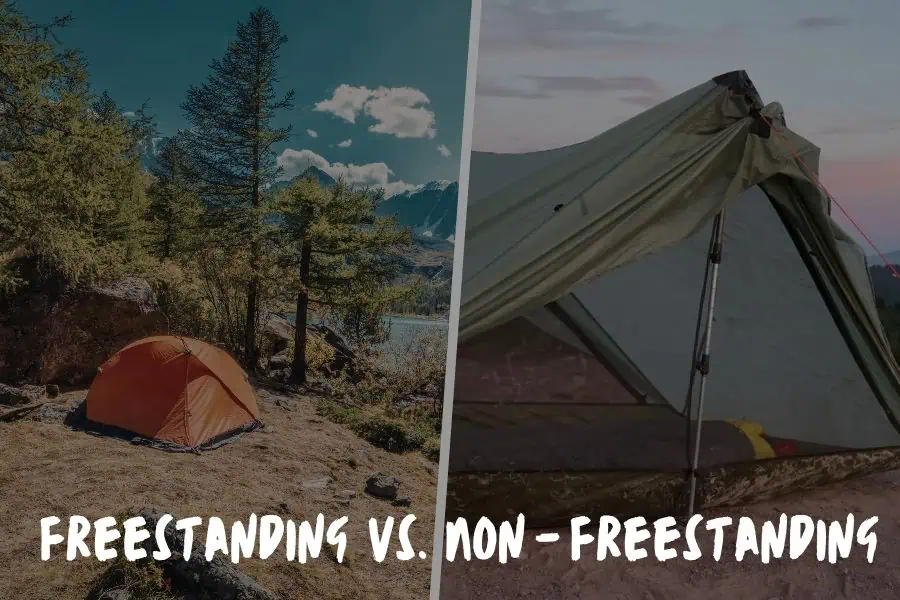
Freestanding tents hold their shape without stakes, which means you can pitch them on hard-packed dirt, rock slabs, or sandy soil without needing to drive stakes for the structure to stand.
For most backpackers, freestanding is the right choice: it is more forgiving of imperfect campsites, easier to move around once pitched, and requires no special skills to set up correctly.
Non-freestanding tents are lighter and less expensive because they shed the weight of a full pole set, relying instead on trekking poles and stakes for structure.
The tradeoff is real: non-freestanding tents require flat, stakeable ground, take longer to pitch correctly, and are less forgiving of campsites where your options are limited.
Every tent on this list is freestanding, which reflects where most backpackers starting out or moving up from a heavier shelter will find the most success.
Also see: Freestanding vs. Non-Freestanding Tents: Which Is Right for You?
Vestibules, Doors, and Livability
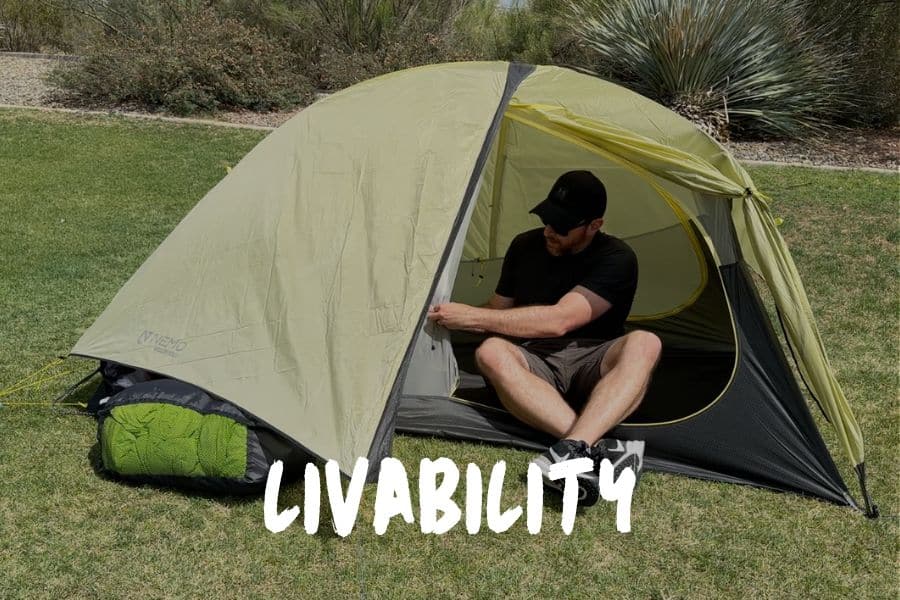
A vestibule is the covered porch area outside the tent door, protected by the rainfly but outside the sleeping area, and it is one of the most undervalued specs in backpacking tent shopping.
A vestibule under 8 square feet handles shoes and a small pack but not much else.
A vestibule above 12 square feet gives you enough room to store a full pack, cook in light rain without getting soaked, and stage wet gear before bringing it inside.
Two-door, two-vestibule designs are worth the modest weight premium for any tent shared between two people: each sleeper has their own entry and their own gear storage, which eliminates the awkward crawl-over that single-door tents require.
Peak height is the other livability spec worth checking: anything under 38 inches makes sitting upright difficult, and anything under 34 inches requires you to change clothes lying down.
See more: Best Tents With Vestibules
Floor Materials and Footprints

Backpacking tent floors use thinner materials than car camping tents to save weight, which makes them more vulnerable to punctures and abrasion on rocky or rooty ground.
Floor denier ratings typically run from 15D on ultralight shelters to 70D on more durable mid-range options: a 15D floor saves meaningful weight but requires a footprint on anything rougher than a soft forest floor.
A footprint is a ground cloth cut to match your tent's floor shape, and it extends the life of the floor significantly by taking the abrasion that would otherwise wear through the floor fabric.
For any tent under $300 with a floor below 40D, a footprint is a worthwhile $20 to $30 investment before your first trip.
See more: Do You Need a Tent Footprint?
Also see: Tent Footprint vs. Tarp: What's the Difference?
Yes, this too: Aluminum vs. Fiberglass Tent Poles
Price: What Changes as You Spend More

Budget backpacking tents in the $75 to $150 range will handle three-season conditions, but they typically use heavier pole sets, thinner rainflies, and less refined ventilation systems.
They are the right starting point for new backpackers who are not yet sure how much they will use the gear.
The $200 to $350 range is where the value-to-performance ratio is strongest: aluminum poles are standard, rainfly coverage improves, and the overall construction tightens up enough for regular use in real conditions.
Between $350 and $600, you are buying lighter materials, better pole geometry, larger vestibules, and construction that holds up across hundreds of nights of use.
Above $600, you are mostly paying for ultralight materials or Dyneema construction, which is worth it for thru-hikers and serious gram-counters but not necessary for most weekend backpackers.
Frequently Asked Questions
How Much Should a Backpacking Tent Weigh?
For a solo tent, under 3 pounds is a reasonable target for most backpackers, with under 2 pounds qualifying as ultralight.
For a two-person tent, under 4 pounds total means each hiker carries 2 pounds, which is comfortable for most trip lengths and terrain.
Weight matters more on longer trips, steeper terrain, and when your overall base weight is already high: if your pack is pushing 35 pounds, shaving 12 ounces off your tent makes a meaningful difference.
See more: How Much Should a Backpacking Tent Weigh?
Is a 2-Person Tent Big Enough for 2 Backpackers?
It depends on the tent and on how much time you spend inside it.
A well-designed two-person tent with two vestibules works fine for two people on warm-weather trips where you are mostly sleeping and moving.
On rainy trips where you are spending time inside, or if you are camping with a dog or a lot of gear, a three-person tent is a significantly more comfortable option even for two people.
Do I Need a Footprint for a Backpacking Tent?
For most conditions, no, but it extends the life of your floor noticeably on rocky or abrasive ground.
Ultralight tents with floors under 20D benefit the most from a footprint: those thin materials wear through faster on rough ground and are more expensive to repair or replace than the footprint itself.
If you camp primarily on soft, well-maintained trail sites, you can skip it and be fine.
See more: Do You Need a Tent Footprint?
What Is the Difference Between a Three-Season and Four-Season Backpacking Tent?
A three-season tent is designed for spring through fall camping in conditions that include rain, wind, and cold but not sustained snow load or extreme alpine exposure.
A four-season tent uses more poles, heavier fabrics, and a more enclosed geometry to handle winter conditions and high-altitude wind, at the cost of more weight and less summer ventilation.
Most backpackers who stay on established trails below treeline will never need a four-season tent.
See more: 3-Season vs. 4-Season Tents
How Long Does a Backpacking Tent Last?
A well-made tent in the $200 to $400 range, stored dry and kept out of prolonged UV exposure, will realistically last 10 or more years of regular seasonal use.
The main failure points are zipper wear, seam separation, and fly coating delamination from UV exposure.
Storing your tent loosely rather than compressed, drying it before packing, and avoiding leaving it pitched in direct sunlight for extended periods will add years to any backpacking shelter.
See more: How Long Do Tents Last?
What Should I Look for in a Backpacking Tent Vestibule?
Size and coverage are the two things that matter most.
A vestibule should be large enough to store your pack and shoes while leaving room to put on your boots without stepping into the rain.
For a solo tent, 8 to 10 square feet of vestibule space is adequate; for a two-person tent, look for at least 10 to 12 square feet per side if the tent has two vestibules.
Coverage matters as much as size: a vestibule with a low fly angle sheds rain effectively but reduces usable headroom, while a taller vestibule is easier to use but can catch wind.
The Bottom Line
The best backpacking tent is the one that matches how you actually camp, not the lightest option on the market or the most expensive one in the store.
Solo backpackers who prioritize weight will find what they need at the top of this list; groups of three who want genuine room to move will find it at the bottom.
If you are buying your first backpacking tent, the Kelty Grand Mesa 2 and the Clostnature One-Person are the picks we point beginners toward most often: reliable construction, honest performance, and a price that does not punish you for still figuring out what you want.
For backpackers who already know they want to go light, theNimbus UL 1 and the NEMO Hornet OSMO set the standard in their respective categories.
Check our full roundups below if you want to go deeper on any specific size category or price range.
More on Backpacking & Backpacking Tents:
- Best 1-Person Tents
- Best 2-Person Tents
- Best 3-Person Tents
- Overnight Backpacking Checklist
- Backpacking Base Weight Guide
Find Your Perfect Tent — In Minutes, Not Hours.
Ask our AI or take the 5-question quiz.
Find My Tent →