

The best tent for stargazing for most campers is the Kelty Far Out Backpacking Tent — it features a full mesh interior and a rain fly that rolls up from inside, letting you watch the stars without leaving your sleeping bag. For rooftop campers who want luxury observatory views, the Thule Approach M is our top premium pick with panoramic skylights wrapping three sides of the tent. If you need flexibility for solo or duo trips, the Sea To Summit Telos TR3 Tent delivers versatile configurations that work as inner-only, fly-only, or combined setups.
10 stargazing tents scored across 7 criteria — mesh visibility, fly removal ease, weather protection, setup speed, weight, interior space, and user reviews. Last updated: September 2026.
Nice, clear weather is an amazing opportunity for stargazing.
And nothing beats being able to remove the rainfly from your tent and gaze up at the wonders of the cosmos.
But to make the most of your stargazing opportunity, you want to make sure you have one of the best tents for stargazing.
I've tried stargazing in many different tents, and some are better than others.
Here are the best tents for stargazing you can find on the market today:
- Best Overall Stargazing Tent: Kelty Far Out Backpacking Tent
- Best Premium Stargazing Tent: Thule Approach M
- Best Ultralight Stargazing Tent: Big Agnes Tiger Wall UL 2
- Best Large Family Stargazing Tent: CORE 9-Person Instant Cabin Tent
- Best Couples Stargazing Tent: ALPS Mountaineering Acropolis Tent
- Best Family Stargazing Tent: CORE 9-Person Extended Dome
- Best Versatile Stargazing Tent: Sea to Summit Telos TR3 Tent
- Best Budget Stargazing Tent: Kelty Late Start Backpacking Tent
- Best Solo Backpacker Stargazing Tent: Eureka! Solitaire
- Best 2-Room Stargazing Tent: Decathlon Quechua Arpenaz Fresh & Black Waterproof Family Camping Tent
Best Tent For Stargazing – Our Top Picks
Thule Approach M
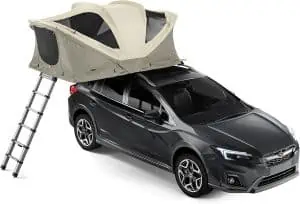
The Thule Approach M is built for campers who want a rooftop tent that doubles as a mobile planetarium.
The defining feature here is the massive panoramic skylight system, which wraps around three sides of the tent and gives you an unobstructed view of the night sky without sacrificing structural integrity or weather protection.
Where most rooftop tents force you to choose between ventilation and stargazing, the Approach M gives you both through dual-density mesh panels that keep bugs out while letting you watch meteor showers from inside your sleeping bag.
The 3-minute deployment system uses a gas-strut assisted lift that one person can operate solo, even after a long day of driving.
At 147 pounds, this is a heavy rooftop tent and you'll need to verify your vehicle's dynamic roof load capacity before mounting it.
The square ladder rungs dig into bare feet during middle-of-the-night trips down to ground level, and unlike some competitors, Thule ships the travel cover separately rather than including it in the box.
This tent is not the right call for anyone who needs to remove their rooftop tent seasonally or who parks in low-clearance garages.
Pros
- Panoramic skylights on three sides for unobstructed stargazing
- 3-minute gas-strut deployment with no assembly required
- Lockable mounting brackets eliminate repeated installation
- Dual-density mesh keeps insects out while maintaining views
- 34 sq ft floor sleeps three adults comfortably
Cons
- Travel cover sold separately instead of included
Best For: Rooftop campers who prioritize stargazing and luxury over packability
Kelty Far Out Backpacking Tent
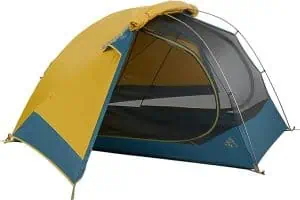
This tent by Kelty definitely gives you the best bang for your buck. It has a decent price tag, and what you get for that price is well worth it.
This tent is designed for stargazing. The inner tent is completely covered in mesh, while the rain fly can be rolled back for nighttime views – even from inside of the tent.
That also means if the weather suddenly changes, you can easily adjust the fly without leaving the comfort of the interior.
This model features two doors, so both you and your camping partner can get in and out of the tent without disturbing one another.
Each door also features a vestibule that offers decent storage space for your gear or dirty shoes.
Pros
- Rain fly can be rolled up or down without leaving the tent
- Two-door design makes getting in and out of the tent easy
- Features two side vestibules for storing gear and muddy boots
- Rather lightweight and great for backpacking
Cons
- Not great for storing stuff inside
Best for: campers looking for the best tent for their money
CORE 9-Person Instant Cabin Tent
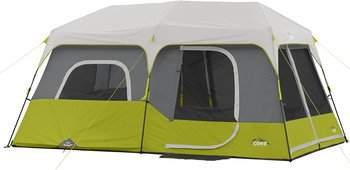
If you're camping with your large family or a group of friends, this tent by Core is a great choice.
First of all, it's a cabin tent. The almost-vertical walls and a center height of 78" really allow you to make the most of the interior space.
You can easily move around the interior without keeping your head tilted. What's also great is that this is an instant tent.
This means the poles are connected to a hub, and all you have to do is extend the frame to pitch the tent.
It's easily done by a single person, so you don't need help from your camping mates.
Every side features large mesh windows, which give you an excellent view of the starry sky at night.
Not only that but the rain fly can also be removed easily since it is attached only with clips, allowing you to stargaze directly through the huge mesh roof.
Pros
- Can set up in just a minute since it's an instant tent
- The center height is 78" and fits most heights
- Its rain fly can be completely removed to reveal the mesh roof and allow stargazing through it
- Features a room divider to create separate sleeping areas inside
Cons
- Quite heavy and bulky when packed
Best for: large families or groups of friends
ALPS Mountaineering Acropolis Tent
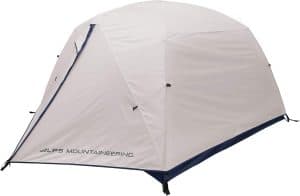
This tent by ALPS Mountaineering is not too small nor too big – ideal for camping couples.
The floor dimensions of this tent are standard for a 3-person tent. However, the almost-vertical walls make a huge difference in terms of headroom.
With a center height of 51", you can sit upright and not feel crowded inside the tent.
The inner tent is completely covered with mesh. During warm, clear nights, you can remove the rain fly and enjoy the views of the night sky.
If the weather gets bad, the rain fly extends all the way to the ground and will keep you safe from the elements.
What's also worth mentioning is that the rain fly creates two ample vestibules, which you can use to store gear outside.
Pros
- Great interior space
- Features two ample vestibules for storing gear
- Stakes are extremely sturdy and wind-resistant 7075 aluminum
- Has two doors
Cons
- Somewhat heavy for a tent of this size
Best for: camping couples
CORE 9-Person Extended Dome
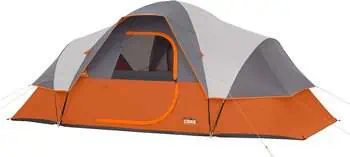
This model by Core has the perfect design for camping with a family and is one of CORE's best tents.
With the floor dimensions of 16' x 9', there's plenty of room for everyone to spread out without disturbing other tent-mates.
What's especially great about this tent is its extended dome design, which you don't often see at this capacity.
Dome tents are known for excellent weather protection, and this model is no exception.
The shape of the tent allows wind to pass over it, instead of blowing directly into the fabric.
And speaking of fabric, 75D polyester is coated with a water-repellent layer and the seams are taped to prevent water from seeping through.
Pros
- The dome design is stable in high winds
- 144 sq ft of living space can fit two queen air mattresses, plus gear
- Mesh fabric ceiling allows you to watch the night sky while laying on your back inside the tent
- Rather lightweight for its size
Cons
- Can take up to 20 minutes to set up
Best for: families camping in windy weather
Sea to Summit Telos TR3 Tent
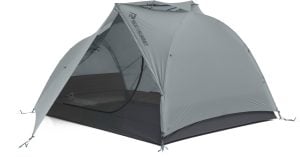
There is such a thing as an ideal tent size for a specific number of people.
But if you're camping solo and sometimes with a partner, this tent model by Sea to Summit works on both occasions.
First of all, it's rather lightweight, so you can easily carry it solo – even long distances.
That's thanks to ultralight materials – DAC aluminum tent poles and 20D ripstop nylon.
Both materials are commonly used for backpacking gear. Their exceptional strength-to-weight ratio makes them a great choice for function.
What's cool about this tent is that you can use just the inner tent, rain fly or both.
In the case of a beautiful, clear night, you can set up just the inner tent to enjoy the unobstructed view of the starry sky.
If it's raining during the day, you can pitch just the rain fly instead, creating a semi-open shelter.
Finally, you can use both for protection against weather elements and insects.
Pros
- Has a vent at the highest point to let warm air out to prevent condensation, which can also be zipped from the inside
- Rain fly can be set up alone to create a semi-open shelter against weather elements
- Weighs around 4 lbs, which makes it suitable for backpacking
- Integrated adjusters allow you to easily control the length of the guylines
Cons
- Quite expensive
Best for: campers in need of a small but versatile tent
Kelty Late Start Backpacking Tent – 2-Person (2019 Model)
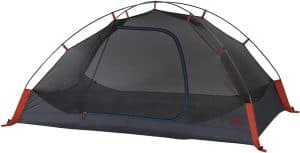
Stargazing is one of those activities you get to enjoy for free, and you don't have to pay a pretty penny for a tent that allows you just that.
This model by Kelty is perfect for every solo camper who enjoys watching the night sky before falling asleep.
This tent doesn't come with tons of bells and whistles, and it's not like it needs them.
This model checks all the boxes: it's affordable, durable, and – most importantly – comfortable.
As a 2-person tent, it doesn't offer plenty of room inside. But thanks to the vestibule area of 7.9 sq ft, there's plenty of room for storing your gear outside.
The rain fly extends all the way to the ground, so you don't have to worry about the rain getting in.
Pros
- Quick-Corner technology makes pitching fast and straightforward
- Low profile makes the tent very stable, even in high winds
- Rather affordable compared to most picks on this list
- Prebent pole design provides decent headspace
Cons
- Somewhat heavy for a 2-person tent
Best for: solo campers
Big Agnes Tiger Wall UL 2
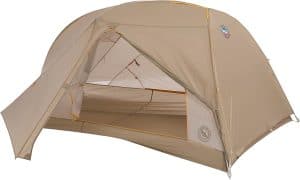
Backpacking and stargazing go hand in hand. And this tent by Big Agnes is the perfect option for such a trip.
This tent weighs just over 2 lbs, so you'll hardly even notice it weighing you down.
It also packs down rather compactly, so it takes little space in your backpack.
But even though it's featherweight, this tent is quite sturdy and durable. It uses DAC aluminum poles, which have an amazing strength-to-weight ratio.
As for the rain fly, it's made of ripstop nylon, which is treated with silicon and features taped seams for waterproofness.
Not many 2-person backpacking tents come with two doors, but this one does.
You can easily get in and out without disturbing your campmate.
Not just that, but you also have two vestibules that provide additional storage space.
Pros
- Weighs just over 2 lbs, which makes it an excellent choice for backpacking
- Made of durable materials, like ripstop nylon and DAC aluminum
- Two vestibules provide 16 sq in of additional storage space
- Media pockets above the sleeping area enable cord routing from your devices
Cons
- Awkward zipper configuration
Best for: backpacking
Eureka! Solitaire
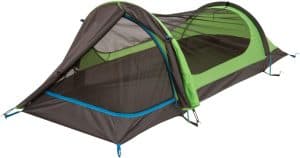
Tents are generally designed with people of average height in mind.
This means that those who are very tall will often feel cramped inside most tents. But that's not the case with this model by Eureka.
With floor dimensions of 96" x 32", there's definitely enough room for most people to sleep comfortably without keeping their knees bent.
The peak height is 28", which allows you enough headroom to get in and out of the sleeping bag.
The poles are also made of 7000-series aluminum, while the tent fabric is polyester taffeta.
Both materials are known for their durability and low weight, which makes them a great option for backpacking.
Pros
- Suitable for tall people with height dimensions of 96" x 32"
- The low profile makes the tent rather stable in high winds
- Features a two-pole design, which takes mere seconds to set up
- Integrated rain fly can be rolled up to enjoy the views
Cons
- Very little storage space available
Best for: tall campers
Decathlon Quechua Arpenaz Fresh & Black Waterproof Family Camping Tent
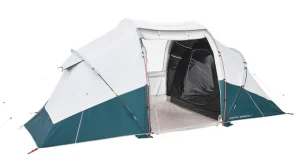
Whether you're camping with family members or you simply want a separate storage space, there are many reasons why one would choose a 2-room tent.
And in the case of stargazing, this is one of the best 2-room tents to choose from.
This dome-shaped tent has two sleeping areas on the ends, while the middle section is reserved for hanging out.
The center height in the living area is 78", so there's plenty of headroom to move around.
What's also great about the living area is the huge transparent window on the tent door.
This allows you to see the night sky even when it might be too cold to keep the door open.
When not needed, it can be stowed away or turned into an awning for additional weather protection.
Pros
- Has two separate rooms of similar sizes, which can be used as sleeping areas or storage rooms
- Tent door can be stowed away or extended into an awning for weather protection
- Black inner fabric keeps the tent dark, even during the day
- Dome shape stands well against winds blowing up to 30 mph
Cons
- Somewhat heavy for a 4-person tent
Best for: longer camping trips
How To Choose A Stargazing Tent
So, what makes a tent suitable for stargazing?
Well, the key is in the details. In this section, we'll go over all the things you should pay attention to when picking the best stargazing tent for your needs.
Full Mesh Canopy
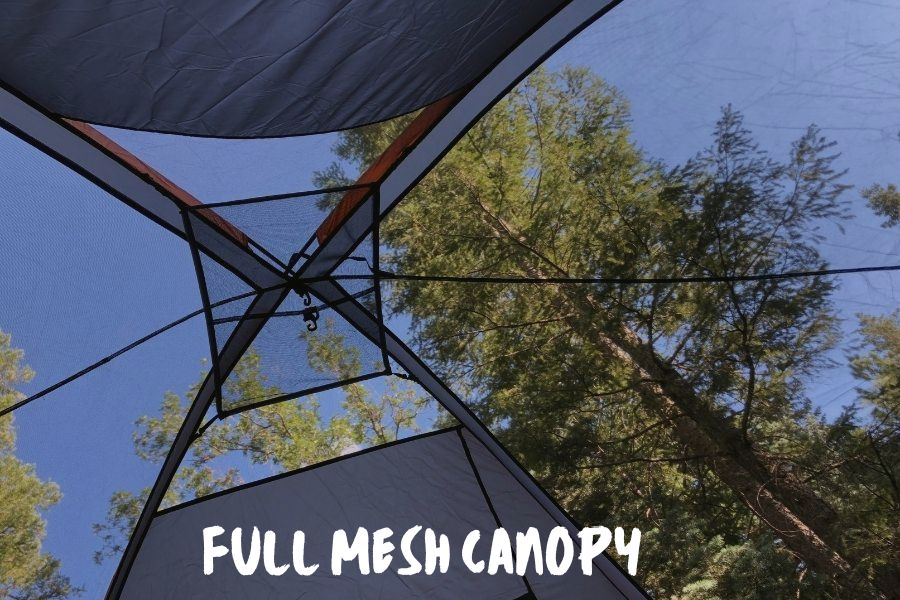
During a warm night, you can remove the rain fly and enjoy the night sky through the mesh walls.
Nowadays, a good portion of the tents available on the market are double-walled, with the inner tent being partially or fully covered in mesh.
Just keep in mind that you'll be a bit colder without the rain fly.
But a blanket or two will keep you comfortable while enjoying the night sky through the mesh, safe from pesky insects.
Minimalist Pole Design
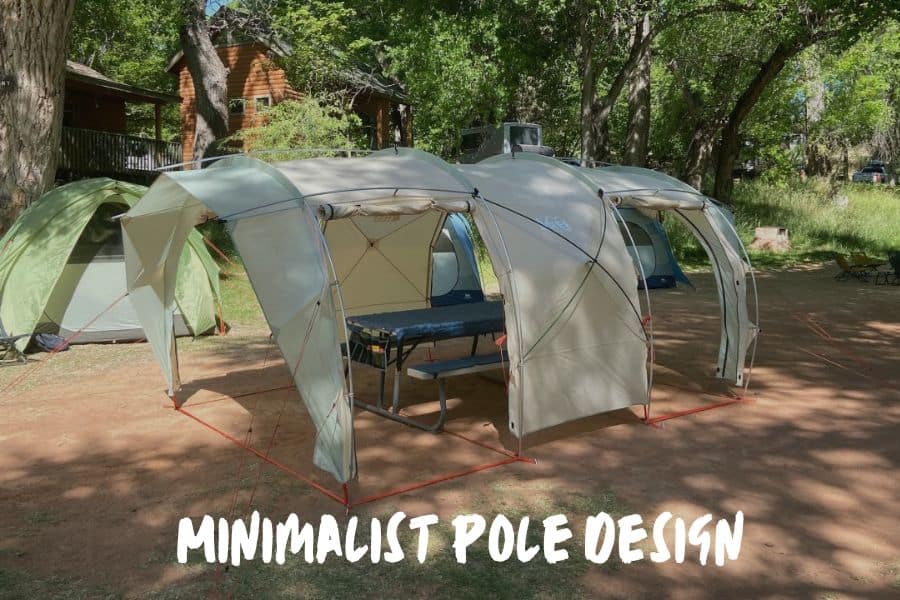
Obviously, you don't want the poles to obstruct the view.
And there's really no need for a complicated pole design – geodesic, for instance – in a stargazing tent.
Plus, more poles mean more weight. And since you'll probably be walking around with your gear while trying to find the perfect stargazing spot, you don't want the tent to weigh too much.
As you can see from our list, most models are minimalistic in that sense, with no more than two or three poles involved, depending on their size.
Light Control
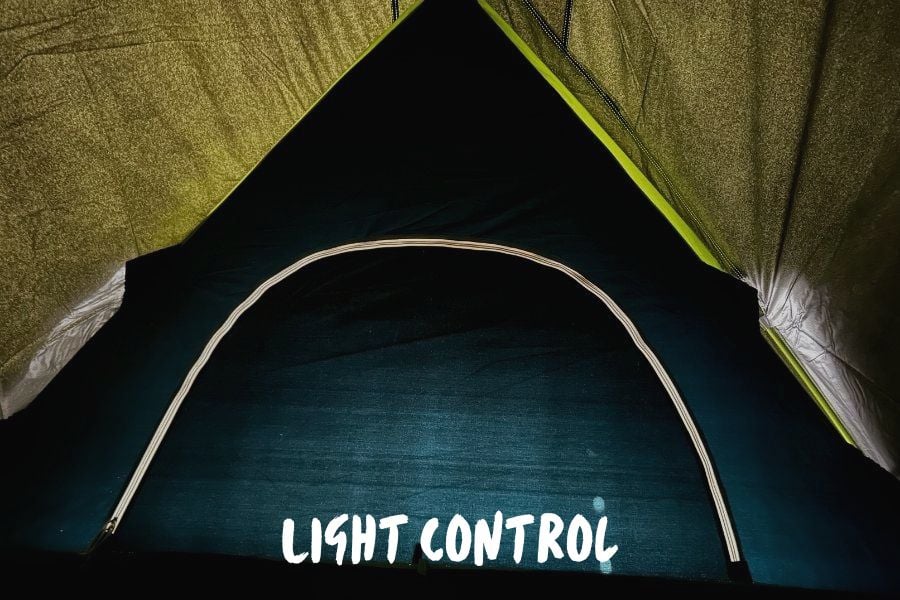
To enjoy the starry sky, you want as little material as possible obstructing your view.
But after a long night of stargazing, you might want to sleep in later than usual.
And in that case, more material is more.
But of course, you can have the best of both worlds.
If the tent has large windows that give you an excellent view of the night sky, make sure the windows also have drapes that you can roll down to keep the sun out.
Furthermore, mesh walls are also great for stargazing. But the rain fly should cover all the mesh – not just to keep the light out – but also the weather elements.
Easy-Pitch Rain Fly
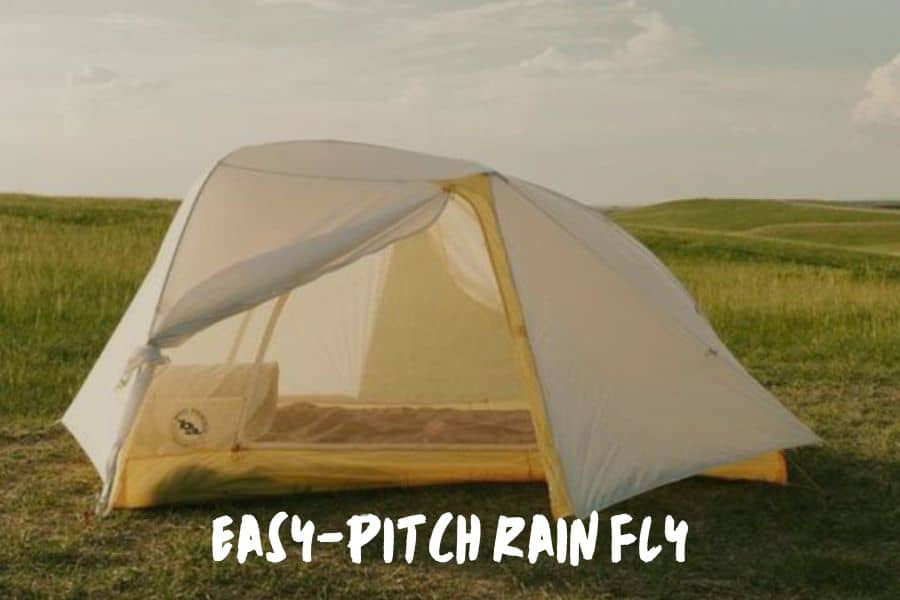
Finally, let's talk about the rain fly. Chances are, you'll be keeping at least one part of the rain fly rolled up to get a glimpse of the starry sky.
Once you're done, you'll have to roll it down so that you can get a good night's sleep.
Well, the last thing you want is to get out of the sleeping bag and spend 10 minutes in the dark trying to do just that.
Therefore, an easy-pitch rain fly is a must. Certain models go a bit further and even allow you to roll it up or down from the inside of your tent.
That means you don't even have to get out of your cozy sleeping bag!
Essential Equipment For Stargazing
Aside from a good tent, what else do you need for a stargazing experience? Here are the essentials:
Telescope
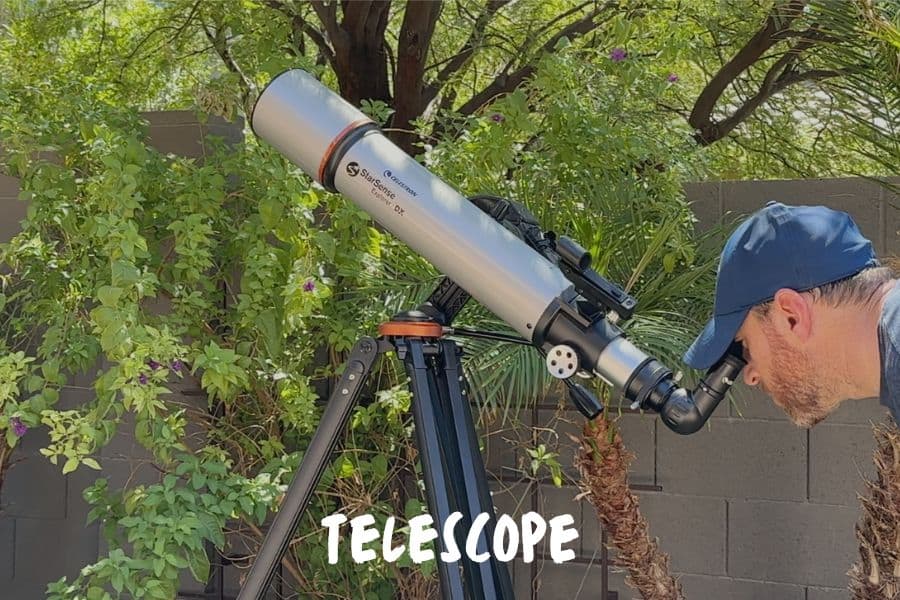
Nowadays, you can find decent telescopes on any budget.
From small tabletop models to huge, computerized alternatives, there's something for every skill level.
A great entry-level model is the Celestron StarSense Explorer DX 102AZ.
The StarSense technology transforms your smartphone into a smart telescope controller, allowing you to easily navigate to celestial bodies without the need for telescope alignment or any pre-existing knowledge of the skies.
Binoculars
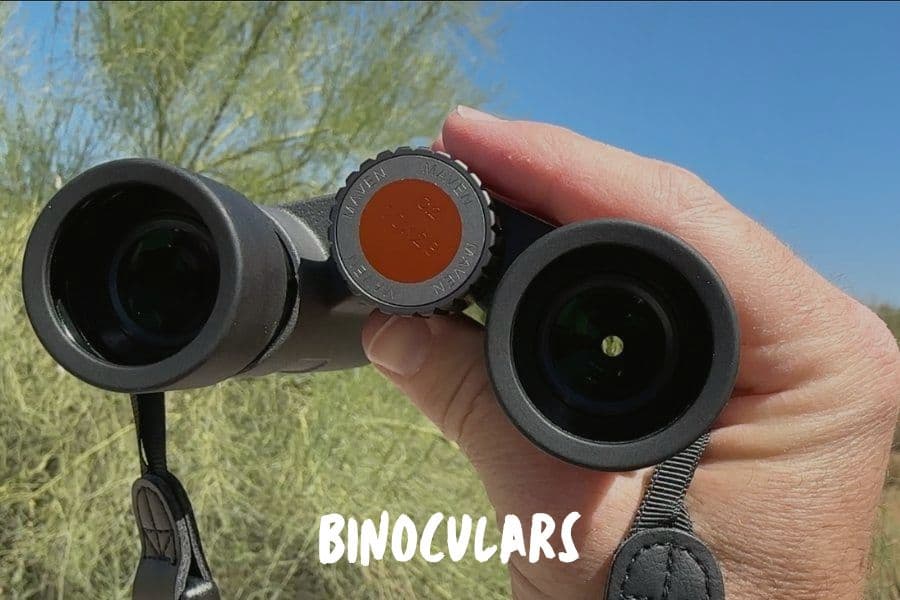
You don't need to get up close and personal with stars to enjoy them.
Binoculars are compact and are a great alternative to telescopes.
You can actually see a lot through them – from craters on the moon to nebulas, and the occasional comet.
Red Flashlight Or Headlamp
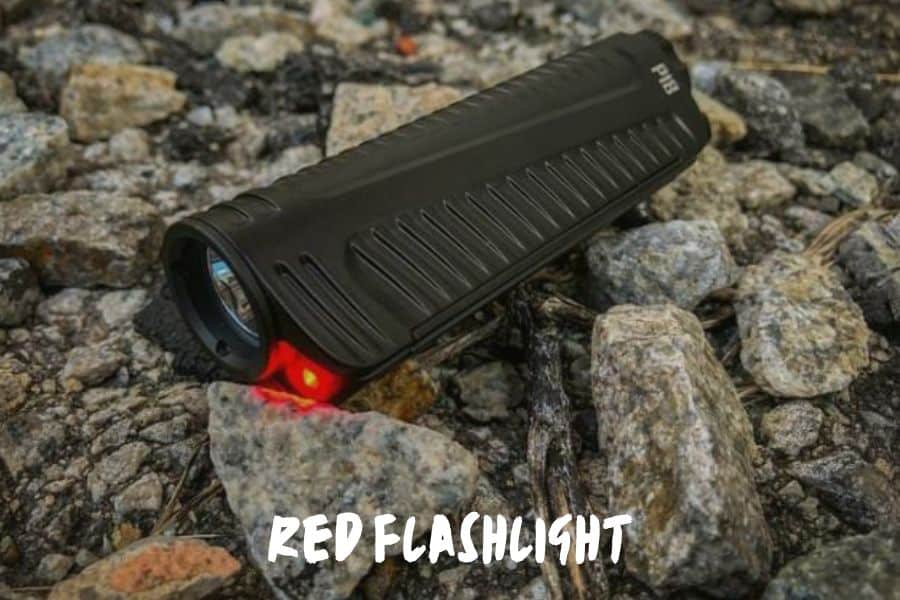
A red flashlight allows you to keep night vision, which is essential for seeing things in detail in the night sky.
Now, you're not using it to look at the stars. They're great if you need a quick look at the star map or need to look for something inside the tent.
If you don't want to wait for your eyes to adjust to darkness again, then a red light source is a must.
Comfortable Seating Or Reclining Chairs
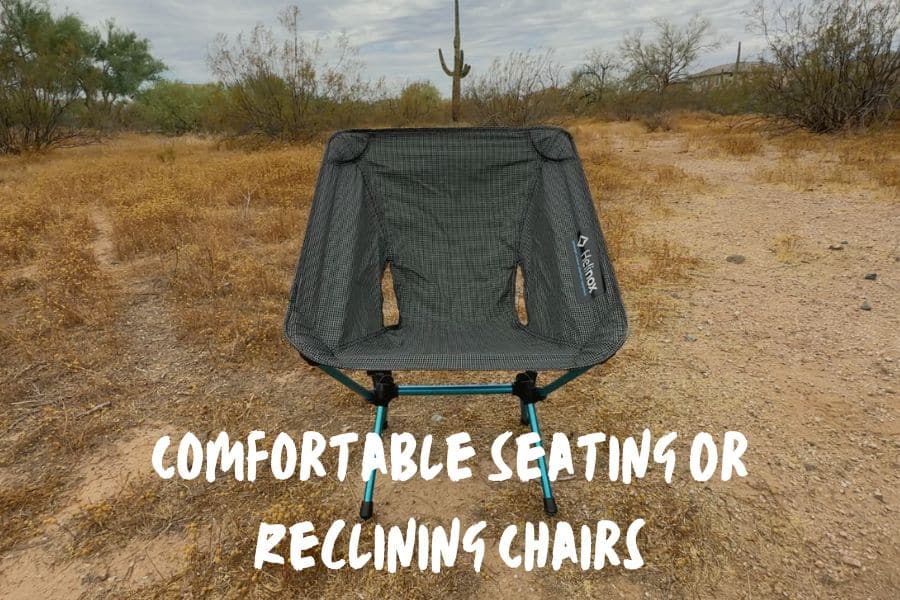
No matter how spectacular the starry sky might be, you won't have fun unless you're comfortable.
Of course, you can lay on your sleeping pad, curled up inside the sleeping bag, and enjoy the sky above you.
But if you're anything like me, a lying position may make you sleepy.
Plus, you might be using a star map or an app, so a sitting position feels more natural.
My personal favorite is a lightweight reclining chair, as it's a suitable middle ground between sitting and lying down.
FAQs
Can I Stargaze Without A Telescope Or Binoculars?
Of course, you can stargaze without any kind of equipment.
However, telescopes and binoculars will give you a much closer look at the stars and other astronomical objects.
Can You See The Milky Way With The Naked Eye?
Yes, the Milky Way can be seen with the naked eye at any time of the year, so long as you are in dark enough skies.
In order to see the Milky Way, you'll need the night to be clear and without light pollution (including the moon).
How Do I Find The Best Stargazing Spots Near My Location?
With the right app and telescope, ANY location can be great for stargazing.
Of course, dark skies will allow you to see much more, but even from my backyard in a major metropolitan city, I can see planets, galaxies, nebulas, and more.
Without a doubt, the SkySafari App is the best stargazing app on the market today. From the ability to connect directly with WiFi-enabled telescopes to a sky compass, it will help you to navigate the night skies with ease.
Are There Any Special Safety Precautions I Should Take While Stargazing?
Make sure the spot you choose for stargazing is free from any potential hazards.
This includes, but is not limited to, unsafe terrain and close proximity to animal dens.
What Are The Best Celestial Objects To See When Camping?
There are so many great celestial objects in the sky year-round.
But a lot will depend on the time of year you are camping in.
During summer, you'll have the chance to see the M31 (Andromeda Galaxy), M27 (Dumbbell Nebula), M11 (Wild Duck Cluster), M57 (Ring Nebula), M17 (The Omega Nebula), M13 (The Great Globular Cluster in Hercules), and more!
During spring, you'll have the chance to see M81 (Bode's Galaxy), M44 (Beehive Cluster), M3, M57 (Ring Nebular), and more!
During fall, you can see M31 (Andromeda Galaxy), M45 (Pleiades Cluster), M57 (Ring Nebula), Double Cluster, and more!
During winter, you can see M42 (Orion Nebula), M45 (Pleiades Cluster), M44 (Beehive Cluster), M81 (Bode's Galaxy) and more!
How Can I Capture Stunning Astrophotography During My Stargazing Sessions?
When trying to capture the night sky, there are a few parameters that are a must.
These include a low aperture (between f/2.8 and f/4), manual focus, long exposure, and a high ISO. Of course, using a tripod is a requisite.
To Sum Things Up
If you plan on stargazing on your next camping trip, make sure to have a suitable tent for such an activity.
We find that Kelty Far Out Backpacking Tent offers the best value for its good quality.
It's relatively affordable, lightweight and completely covered in mesh, so you can enjoy the sky through the walls.
We hope that you find our reviews helpful and have the best time looking at the night sky on your next trip!
Learn More About The Outdoors At Nighttime!